Carel Kraayenhof
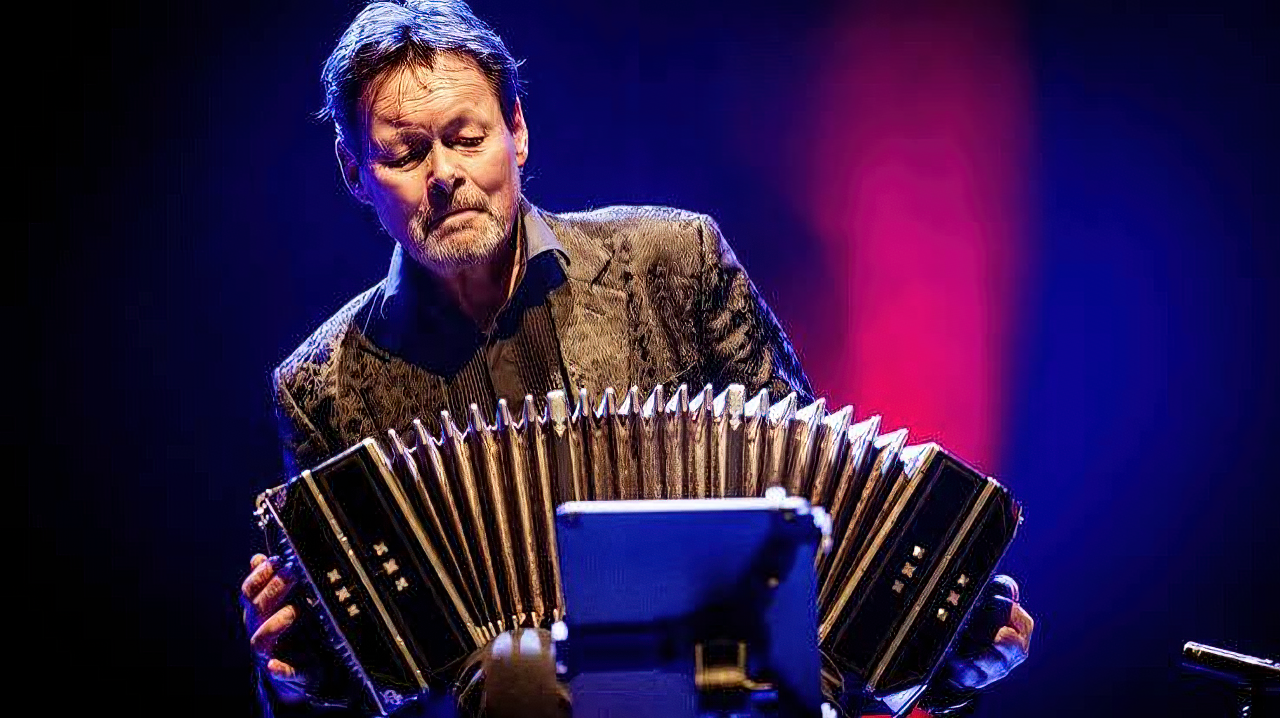

Portrait of a musician
How a boy from the Dutch province of Brabant brought the most melancholy instrument in Buenos Aires to the Low Countries — and brought an entire country to a standstill with it.
Who he is
In one paragraph
Carel Kraayenhof is the bandoneonist who lifted the tango out of the Dutch late-night café and placed it on the stage of the Concertgebouw. He is self-taught on an instrument with a reputation for being unlearnable, the composer of more than eighty works, and, since one Saturday morning in 2002, the best-known musician in the country even among people who never listen to tango. His career reads as one long journey: from Brabant, by way of the Amsterdam folk clubs and Buenos Aires, back to the Dutch polder — where he taught the wistful sound of the bellows to feel at home.
A Brabant childhood at the piano
1958 – late 1970s
Kraayenhof was born on August 15, 1958 in Aalst, near Waalre, and began piano lessons at eight. Classical repertoire first, but ragtime as well — that bouncing left hand would serve him well later on. The real turn came through his brother Jaap, who introduced him to Irish, Scottish, and English folk music; together the two formed the duo Korte Metten.
That repertoire called for other instruments. In the mid-1970s he taught himself the melodeon and the English concertina: button instruments with bellows, where every button sounds one note on the push and another on the pull. Without knowing it, he was laying down the fingering for what came next.
The bandoneón, and what came after
Early 1980s
In the early 1980s he heard a bandoneón for the first time. The sound never let go of him. He found his first instrument through the Eerste Utrechtse Trekzak Sociëteit, the Utrecht squeezebox society. The bandoneón itself is a German invention — meant for churches that could not afford an organ — carried by sailors to the harbors of Buenos Aires, where it became the voice of the tango.
It is an instrument that gives nothing away for free: the buttons do not follow the scale, and the same button sounds different opening the bellows than closing them. Kraayenhof taught himself, without a teacher and without a method, and over the years built a tone of his own: dark, breathing, with the air audible in the bellows.
Piazzolla and Buenos Aires
1987 – 2002
In 1987 Ástor Piazzolla himself invited him to New York as bandoneón soloist for the Broadway production Tango Apasionado — his international breakthrough. A tour of Argentina with Osvaldo Pugliese, the grand master of the old school, followed in 1990.
The bond with Argentina held. In July 2002 he traveled to Buenos Aires with Sexteto Canyengue to mark the tenth anniversary of Piazzolla’s death; the journey became the documentary Nostalgia. Piazzolla’s music — above all Adiós Nonino, written after the death of his own father — remained the heart of his repertoire.
The bandoneón does not complain. It breathes, and in that breath is everything left unsaid.The heart of Piazzolla’s tango nuevo
February 2, 2002
Four minutes that changed everything
At the wedding of Prince Willem-Alexander and Máxima Zorreguieta in the Nieuwe Kerk in Amsterdam, Kraayenhof played Adiós Nonino. The bride, whose father was not beside her that day, broke into tears — and more than fifty-five million viewers worldwide watched it happen.
In one unbroken take he went from respected colleague to national figure. The record of the wedding music went triple platinum in the Netherlands. More important to him: it opened the doors of symphony orchestras, concert halls, and international stages, and it made the bandoneón an instrument the Dutch public knows by name.
Composer and collaborator
Ongoing
Alongside his performing, Kraayenhof is a composer: more than eighty works of his own, from solo pieces to full orchestral scores, in which tango, classical music, and South American folk traditions run into one another.
He has played with the Metropole Orkest, the Rotterdam Philharmonic Orchestra and the Concertgebouw Chamber Orchestra, and with a strikingly broad range of soloists: Ennio Morricone, Joshua Bell, Lavinia Meijer, Herman van Veen, and Bløf. That range is not a strategy but a temperament — he goes wherever the instrument still has something to say.
Passing it on
From 1993
In 1993, together with Leo Vervelde, he founded the Argentine Tango department at the Rotterdam Conservatory: the first place in the Netherlands where tango was taught as a serious course of study, with attention to the phrasing and the rhythmic accents that appear in no score.
He set up exchanges with the Escuela de Música Popular de Avellaneda in Buenos Aires and brought Argentine guest teachers to Rotterdam. In this way Dutch tango gained a whole generation of players instead of a single exception.
Awards and honors
Recognition
What remains
In closing
What is remarkable about Kraayenhof is not that he plays an Argentine instrument, but that he has let it take root. In Melancholy in the Polder the bandoneón sounds above the Dutch landscape as though it had always stood there: the same gray light, the same restrained longing, the same horizon that never ends.
That is the work of a lifetime: to play a sound from elsewhere so long, and so patiently, that it becomes a sound from here as well.